When Things Fall Apart: What Will You Create From What's Left?

Updated: Jul 29
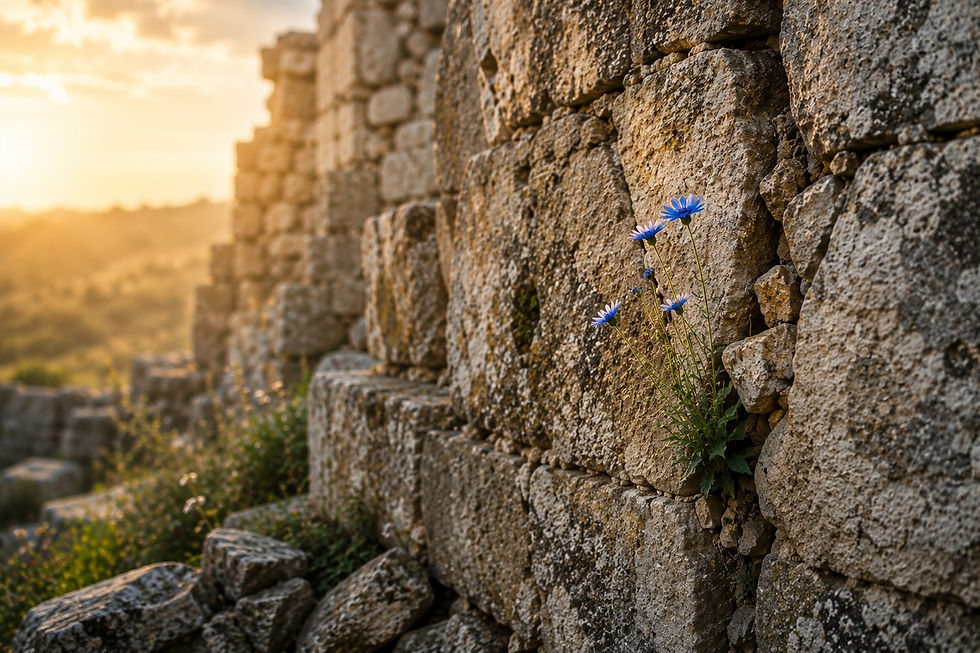
I recently found myself reflecting on Tisha B'Av, a day in the Jewish calendar that commemorates not just one tragedy, but centuries of collective heartbreak - from the destruction of Jerusalem's ancient Temples to exile, persecution, and other turning points that forever altered Jewish history.
Each generation pauses to remember the losses and to wrestle with what it means to rebuild after unimaginable devastation. What struck me wasn't simply the devastation. It was the insistence that devastation would not have the final word..
Across more than two thousand years of heartbreak, the tradition doesn't ask us to look away from suffering. It asks us to remember it. To honor it. To allow it to change us. And perhaps most importantly, to ask what comes next.
One of the ideas I love most from Jewish mysticism is that every descent carries the hidden possibility of ascent.
Every breaking creates the conditions for something new to emerge.
Not because tragedy is beautiful. Not because suffering is somehow "meant to be." But because human beings possess an extraordinary capacity to transform what has happened to us into something that serves life.
The very place of greatest brokenness can become the place where compassion deepens. Where wisdom takes root. Where creativity awakens. Where connection becomes possible. Not after the grief. Within it.
That feels especially true to me right now. Cancer has reminded me (again) that healing isn't about getting back to who we were before everything changed. It's about becoming someone we never could have been otherwise.
I've come to believe we're all capable of becoming alchemists in our own lives, allowing our hardest experiences to expand our capacity to transform pain into compassion, grief into presence, fear into courage, and even our most gut-wrenching moments into something that helps another human being feel a little less alone.

Sometimes transformation looks dramatic. More often, it looks surprisingly ordinary.
It looks like feeding your mom when Alzheimer's has slowly stolen so much, yet somehow hasn't taken away her ability to smile when she tastes watermelon.
It looks like laughing so hard you momentarily forget what you're carrying.
It looks like deciding that flaming chemo-induced folliculitis all over your scalp is somehow preferable to the debilitating nausea from your last cancer rodeo... and realizing you've officially entered a very strange chapter of adulthood.
It looks like writing an entire blog about your radiated vagina, only to discover that honesty has a funny way of making complete strangers on the other side of the world say, "Thank you. I thought I was the only one."
It looks like finding moments of absurdity in the middle of terrifying scans, difficult conversations, and waiting rooms that seem to exist outside the laws of time.
It looks like making someone laugh when they expected another inspirational quote.
It looks like sending a text. Making soup. Creating art. Listening without trying to fix. Holding someone's hand. Offering steadiness to someone who's finding their footing.
History reminds us that people have always faced devastation: Illness, loss, displacement, war, broken dreams, broken hearts.
Cancer isn't a gift. Alzheimer's isn't a gift. Destroyed homes, exile, and unimaginable loss are not gifts. But love can still emerge from the ashes.
Again and again throughout history, individuals and communities have demonstrated an astonishing ability to build something meaningful from what remained. To transform memory into identity. Questions into wisdom. Longing into hope. Survival into responsibility. And suffering into deeper compassion.
Perhaps that's one of life's greatest invitations. Not to pretend devastation is beautiful. Not to rush toward silver linings before we've honored what's been lost. But to remember that ruins don't have to be the end of the story.
So maybe the question isn't "Why did this happen?", but instead:
What will you create from what's left?
Because we are capable of transforming pain into something that keeps another person warm: A meal, a melody, a joke, a movement, a work of art, a conversation that let's someone finally exhale, a hand reaching back for someone who's still finding their way.
The pieces may not fit together the way they once did, but they can become something honest. Something meaningful. Something unexpectedly beautiful.
And perhaps that's how healing works... not by erasing the tragedy, but by creating something that couldn't have existed without it.
Jennifer Dolinka, M.S., is a Certified Hypnotist, trained conflict analyst, and creator of the Clear Calm Confident™ method. After years working internationally in complex organizational environments, she now supports clients around the world in navigating something even more fundamental: the inner conflicts that keep them stuck.
Jennifer helps self-aware, capable humans release anxiety and self-doubt, shift limiting beliefs, ease stress and discomfort, and reconnect with their own clarity and inner wisdom. She specializes in supporting professionals, students, and survivors who are ready to move from overwhelm to grounded confidence.
Her work blends science-informed hypnotherapy, experience-based insight, and a deep respect for the mind–body connection. Above all, Jennifer’s approach is collaborative and empowering – helping clients change patterns at the root so life can move forward with greater ease and self-trust.
Curious what your mind is capable of? Book a complimentary Discovery session to explore what's possible.


Comments